
The Black Soldier Fly (BSF) industry is maturing at an incredible pace. While Western firms have historically led in high-level safety certifications (GMP+, HACCP) and premium market entry, China has carved out a parallel path focused on massive volume and unrivaled CapEx efficiency.
In a landmark episode of the Black Soldier Fly Leaders Podcast, host David Tavernor sat down with Ruilong Zheng—a global insect protein expert and the founder of the International Insect Protein Industry Conference (IPIC). Ruilong’s insights bridge the gap between global animal nutrition theory and the heart of the Chinese industrial boom.
Hear the full podcast from David featuring Ruilong
At SoldierFlyHub, we’ve synthesized this conversation into a strategic report that bridges Western theory with Chinese industrial reality.
1. The Three "Hidden Truths" of the Chinese Market
Understanding the Chinese BSF sector requires looking past "glossy" marketing and into the structural logic of their production.
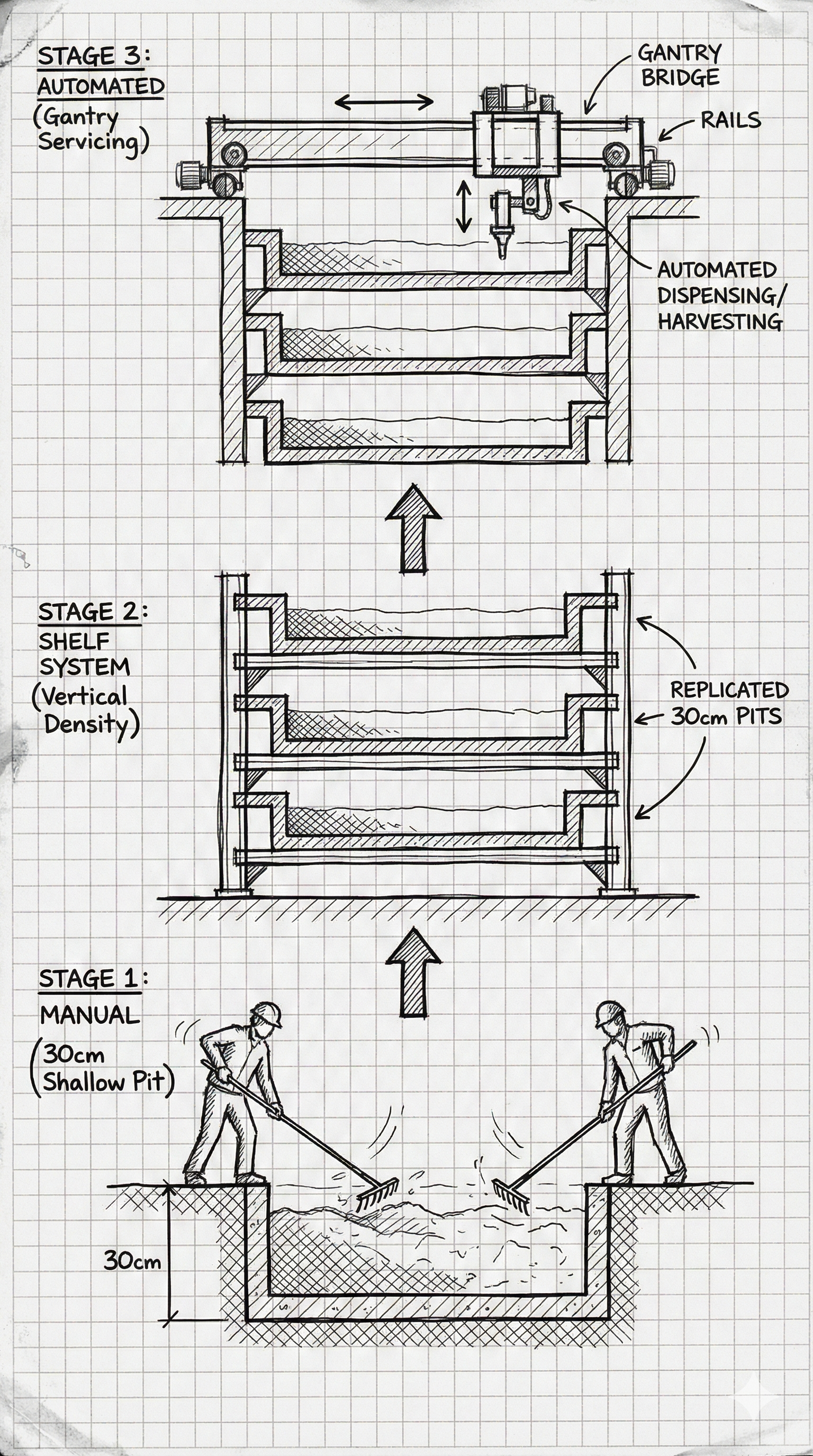
Truth #1: The "Pit-to-Plug" Evolution
Western engineers often attempt to build "clean-room" robotics from the ground up. In contrast, Ruilong explains that Chinese automation is often the result of "Automated Manual Labor." * The Logic: Many facilities began as manual "Pit Farms"—simple concrete rearing pits. As they scaled, they didn't replace the pits; they layered them and added mechanical gantry systems to service them.
- The Result: This model is significantly cheaper to build (CapEx), utilizing stainless steel and iron rather than expensive specialized plastics.
Truth #2: The "Physics of Texture" (Texture vs. Crawl)
A major content gap in BSF literature is the specific "physics" of larval escape. Ruilong highlights a biological trigger: Larvae can only crawl vertically on moist surfaces.
- The Strategic Fix: By mastering substrate Viscosity, operators can prevent "crawling out" without needing complex physical barriers. If the surface is kept dry or the substrate texture is stabilized, the larvae remain contained naturally.
Truth #3: The Low-Energy Cooling Advantage
While Western facilities often rely on energy-intensive HVAC systems, many Chinese facilities have historically leveraged geothermal or groundwater cooling loops.
- The Caveat: While this "hack" has provided a massive cost advantage, 2026 regulations in China (under the Ministry of Ecology and Environment) have tightened significantly regarding groundwater extraction and thermal pollution.
- The Lesson: Low-energy cooling remains a cornerstone of Chinese cost-efficiency, but it is shifting toward closed-loop geothermal systems to meet modern environmental standards.
2. The Protix-China Nutrition Framework: Practical Solutions
Applying Dutch nutritional precision to Chinese industrial scale has led to several unique mechanical solutions for biological bottlenecks.
The Heat/Density Trade-off
There is a common Western push toward maximum "Rearing Density." However, Ruilong warns that this can be a financial trap.
- The Challenge: Higher density generates intense biological heat.
- The Trade-off: The cost of the electricity required to "cool" a high-density crate often outweighs the profit from the extra larvae produced. Ruilong advocates for a Sub-Optimal Density model that allows for passive cooling and lower OpEx.
The "Mesh Bottom" Strategy
Managing moisture in "Catering Waste Slurry" is a primary struggle. Instead of adding expensive bulking agents (like wheat bran), many Chinese sites utilize mesh-bottom crates.
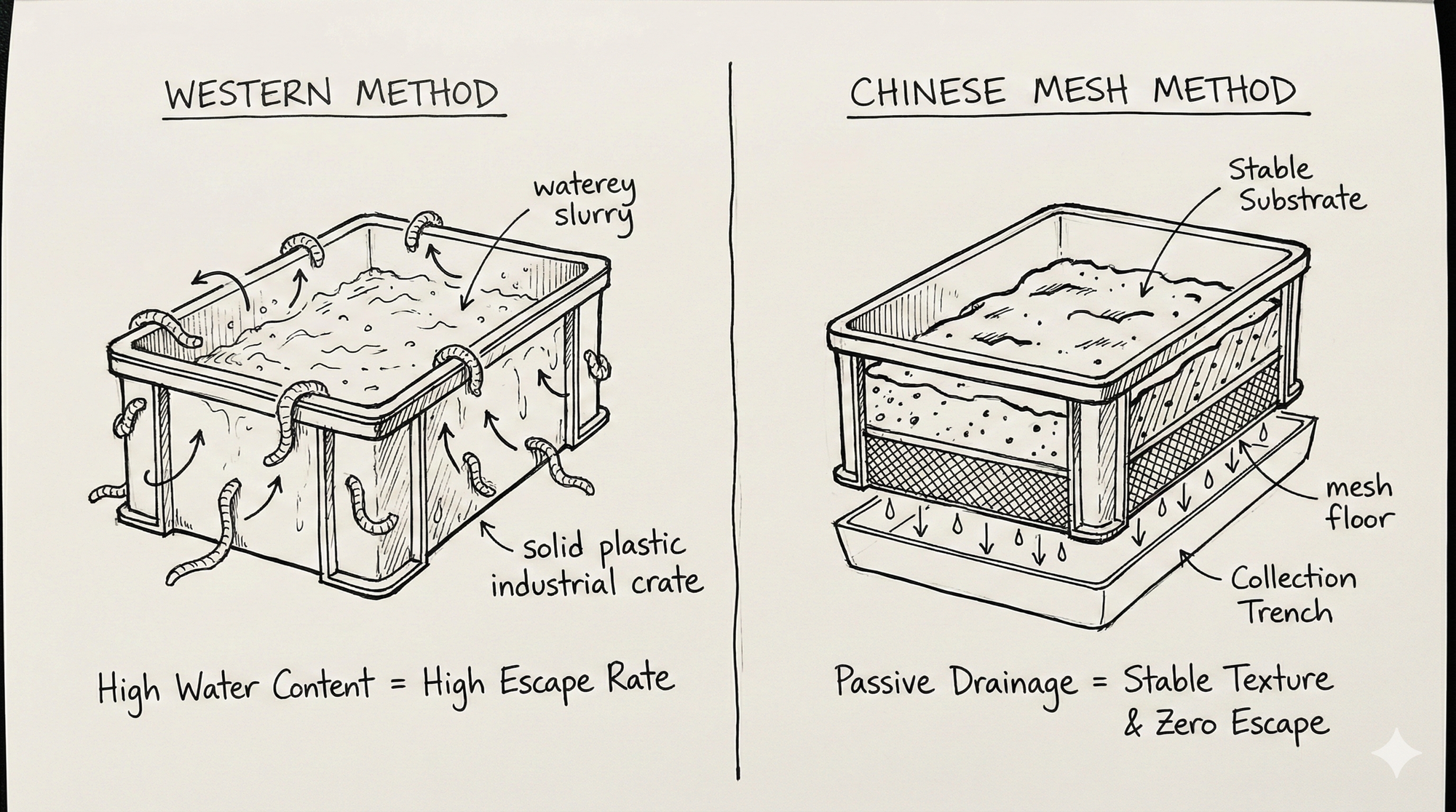
- The Mechanism: Excess liquid passively drips through the mesh into collection trenches.
- The Hygiene Disclaimer: While this saves on feed costs, it requires a sophisticated leachate management system and frequent floor sanitation to maintain the industrial hygiene standards required for global market entry.
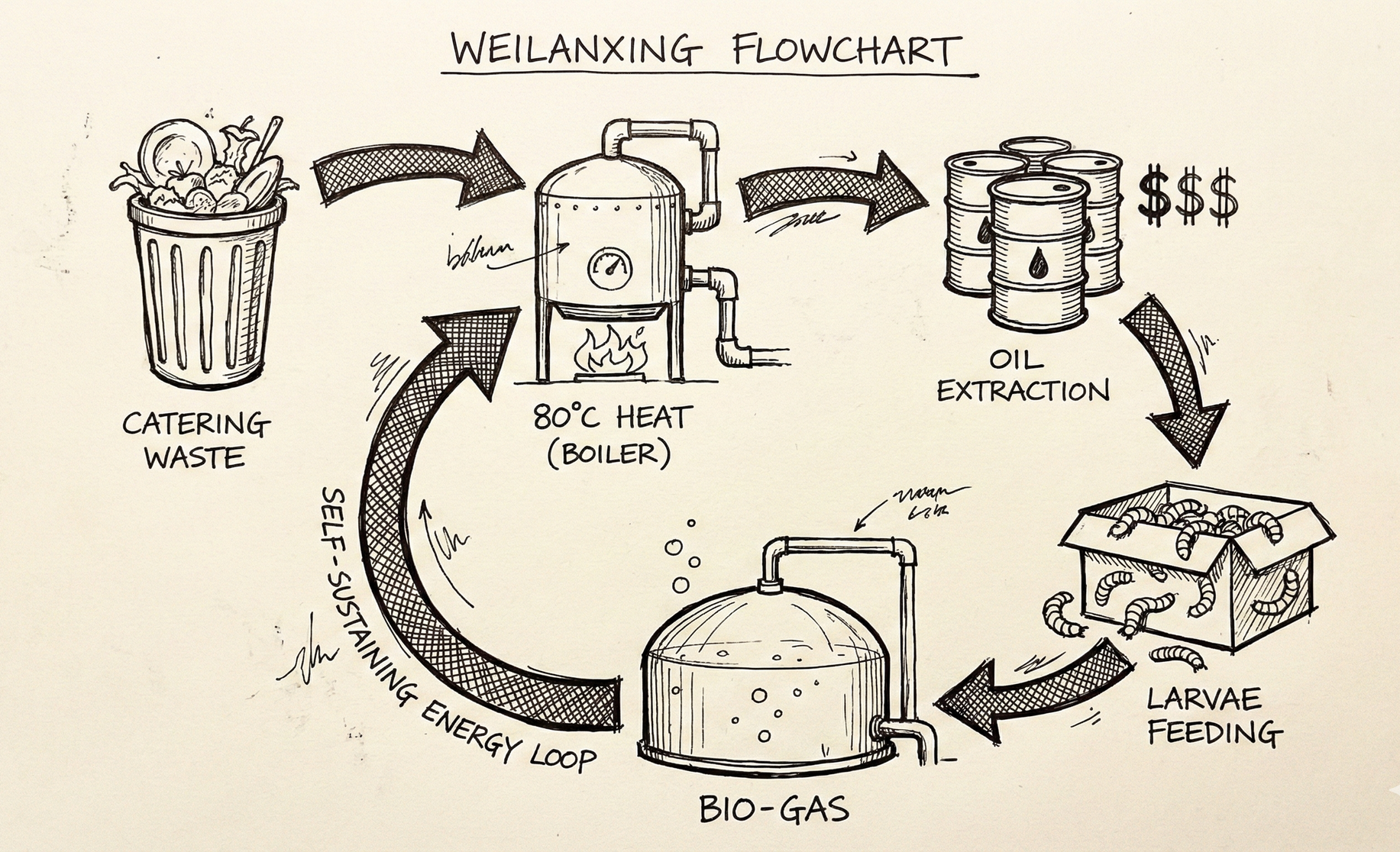
The Circular Revenue Loop: The 80° C Rule
China’s handling of municipal catering waste is a masterclass in pre-processing. Before the BSF are even introduced, the waste is treated:
- Thermal Extraction: Waste is processed at 80° C, allowing for the separation of lipids.
- Immediate ROI: This extracted "Gutter Oil" is sold as Biodiesel, creating revenue before the first larva is harvested.
- Bio-Gas Integration: Wastewater is sent to fermentation tanks to produce Bio-Gas, which is then used to power the 80° C boilers and larval dryers, creating a self-sustaining energy loop.
3. Industry Benchmarking: Players to Watch
Based on Ruilong’s insights, these four entities represent the "brightest" points of the Chinese sector:
- Weilanzing: The benchmark for stability. They process 130 tons/day of municipal waste with a high-reliability energy loop.
- Unique (Guangzhou): One of the world's largest BSF egg producers, currently expanding its global supply chain.
- Inspro (Elvis Yu): Leaders in modular, crate-based automation that balances high-tech precision with agricultural reality.
- Xingmei: An active exporter of BSF technology, currently navigating pilot and full-scale implementations in Nigeria and Mexico.
Conclusion: Bridging the Gap
The Chinese BSF market isn't just a "low-cost" alternative; it is a different philosophical approach to bioconversion. While the West leads in Safety Certifications and Premium Aquafeed, China leads in Process Integration and Waste Volume. For the global industry to truly "take flight," we must combine Western regulatory rigor with the industrial "Steel & Iron" logic of the East.
Download the Updated Technical Fact Sheet
We have finalized the BSF Leaders Fact Sheet with full glossaries, the latest "Money Numbers," and detailed leachate management disclaimers.