
In the global Black Soldier Fly (BSF) economy, the headlines are captured by Industrial Titans raising $100M+ to build centralized factories. Their goal? Replace fishmeal with high-grade insect protein.
But on the latest Black Soldier Fly Leader's Podcast, Dave Littere (Future Acres Urban Farming) provided a masterclass in the Inverted Revenue Model. For the operator in a high-density metro like Washington D.C., the Fly is the secondary product. The Service is the goldmine.
The Littere Model vs. The Industrial Titan
To understand why a small-scale operator can be profitable while giants struggle with overhead, we have to look at the flow of capital.
| Feature | The Industrial Titan | The Littere Model |
| Primary Revenue | Sales of Protein Meal & Oil | Tipping Fees (Collection) |
| Logistics | Centralized (Waste comes to Fly) | Decentralized (Fly goes to Waste) |
| Success Metric | Feed Conversion Ratio (FCR) | Route Density & Service Contracts |
By deploying Mobile Compost Commands (MCCs)—modular units—Dave eliminates the 40-mile trek to regional landfills. He isn't just farming; he is performing Rapid Volume Reduction (4 tons in 10 days) at the source.
The Moisture War: Beyond the Hustle
Dave highlights the single greatest hurdle for urban processors: The Seasonality of Garbage. In the D.C. market, Melon Season sends moisture levels skyrocketing. While Dave manages this Moisture War through intuition and hands-on biology, scaling a decentralized model requires moving from hustle to engineering.
1. The Squeeze Test vs. Oxygen Transfer
Industry expert Sofia Katzin suggests the Squeeze Test: if water leaks out when you compress a sample, your larvae are at risk.
The danger of high-moisture waste isn't just temperature—it is Oxygen Transfer Limitation. Excess water turns the tray into an anaerobic sludge that blocks gas exchange. While water causes evaporative cooling (slowing bioconversion), the real threat is that the larvae suffocate and drown. This is what triggers the crawl-out behavior many beginners mistake for hunger.
 Soldier Fly Hub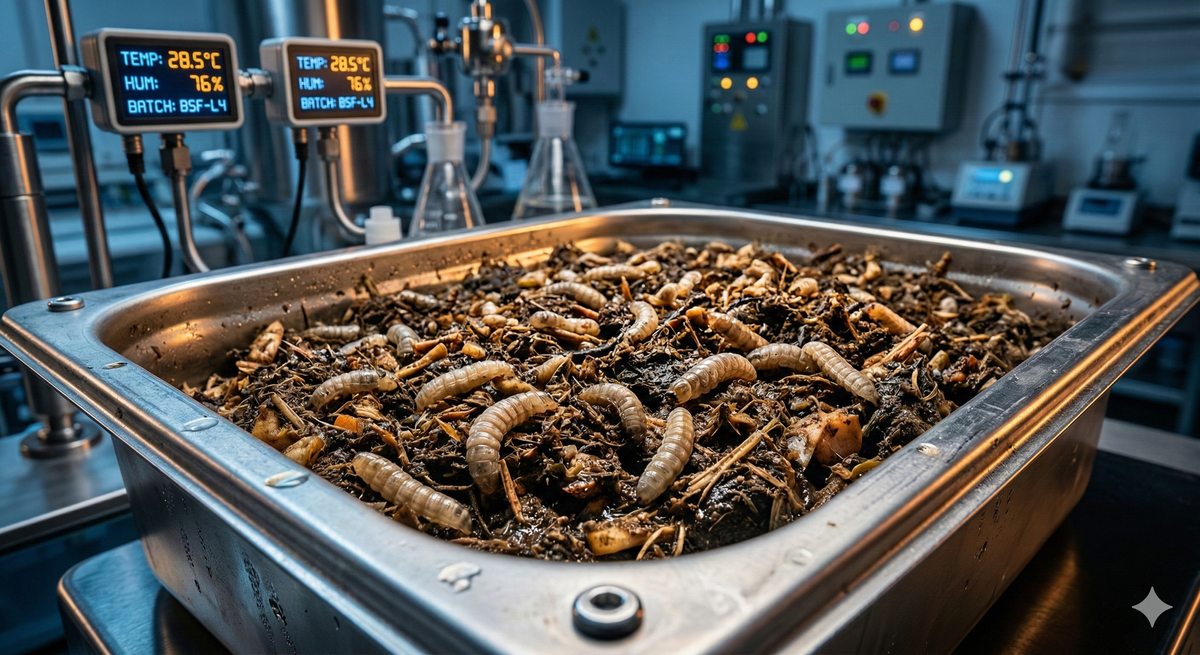
2. The Requirement of Structure
Standardization means more than just removing water. Bob Holtermans (Insect Engineers) emphasizes that roughly 10% of your feedstock should be dedicated to structure. By adding porous, dry anchors like stale bagels or bakery scrap, you aren't just soaking up juice—you are creating the air-channels necessary for the larvae to breathe and digest efficiently.
 Soldier Fly Hub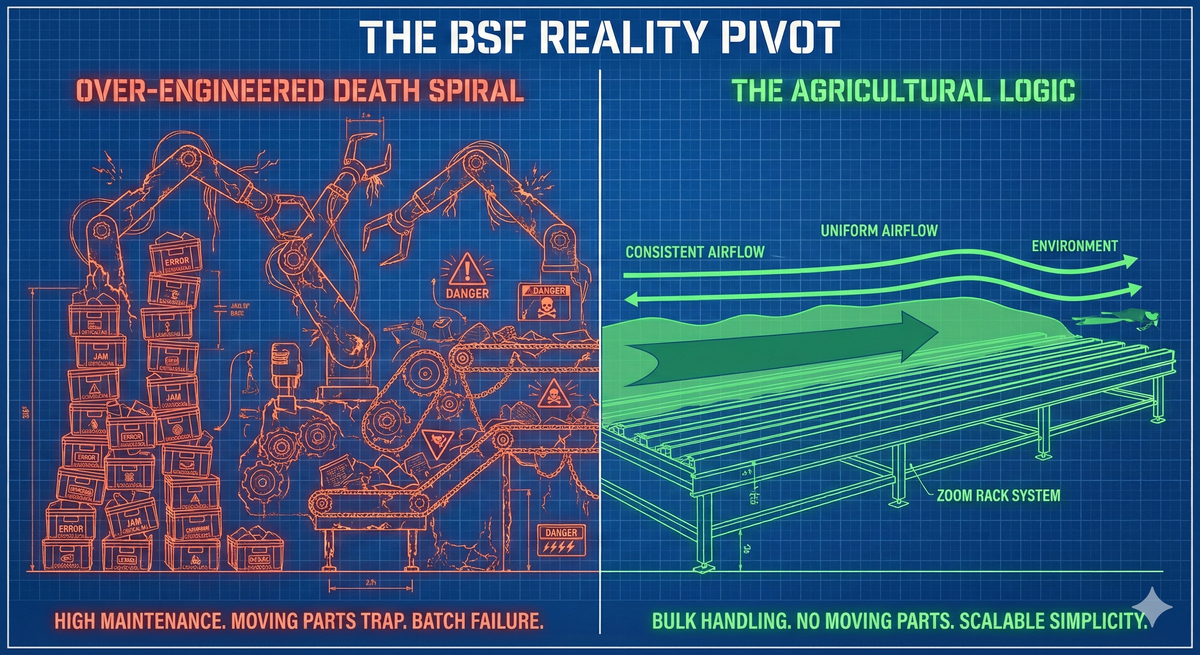
3. The Industrial Mass Balance
To hit the industry-standard sweet spot of 70% moisture, professional operators use a Mass Balance calculation. If you receive 100 kg of melon waste at 90 % moisture (M1), and your dry bread waste is 10% moisture (M2):
$$W_{2} = W_{1} \times \frac{M_{1} - M_{target}}{M_{target} - M_{2}}$$$$W_{2} = 100 \times \frac{0.90 - 0.70}{0.70 - 0.10} = \mathbf{33.3\text{kg}}$$
The Strategic Intelligence: For every 100kg of wet waste, you must secure ~33kg of dry Structure waste. Dave currently pays for chicken feed to bridge this gap, but the path to peak margin lies in securing these Dry Anchors for free via local urban partnerships.
Operational Audit Checklist: Is Your Region BSF-Ready?
1. The Tipping Fee Gap
- [ ] Does your local municipality have an organic waste mandate?
- [ ] Is the Gate Fee at the nearest landfill high enough to justify decentralized processing?
2. Dry Anchor & Structure Audit (5-Mile Radius)
- [ ] Tier 1 (Starch/Structure): Stale bread, bagels, or day-old bakery outlets.
- [ ] Tier 2 (Fiber/Porosity): Coffee chaff or dry spent grain.
- [ ] Tier 3 (Amendments): Biochar (High cost, but elite for moisture control and Engineered Frass value).
3. Logistical Density
- [ ] Can you place a modular unit within 15 minutes of your waste producers to minimize ton-miles?
- [ ] Is there a centralized location for Shredding to ensure a uniform particle size before distribution?
The SoldierFlyHub Verdict: > Profitability in the urban BSF model is won at the shredder. By combining the hustle of local waste collection with the engineering of mass balance and gas exchange, operators like Dave Littere are de-risking the Valley of Death one bin at a time.